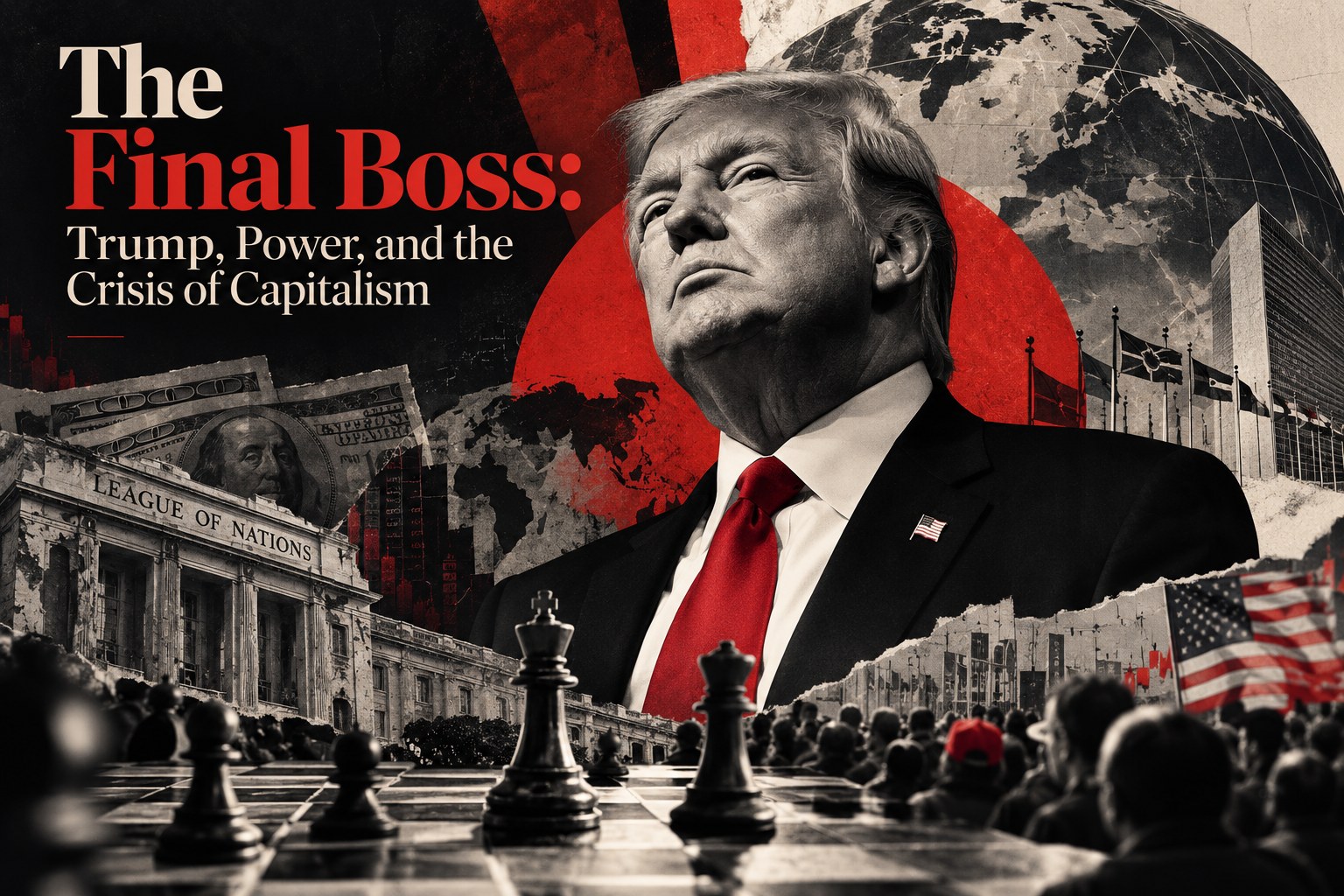
I believe Donald Trump represents, in many ways, the final product of capitalism—or at least one of its most extreme political expressions. He feels almost like the “final boss” of a video game: not because he emerged from nowhere, but because he embodies and amplifies tendencies that have been developing within the system for decades.
One of his defining characteristics, in my view, is individualism disguised as a common cause. He presents highly personal ambitions and interests as if they were collective ones. Perhaps this is also what makes him so effective at mobilizing people. He understands how to exploit the perception of a “greater evil”—and, when necessary, to manufacture the image of one—in order to justify political actions that might otherwise be difficult to defend. By creating an existential threat, almost any response can be presented as necessary.
What concerns me most, however, is not only Trump himself, but what his political project reveals about the international system.
I find the logic expressed in the current U.S. National Security Strategy deeply alarming. At certain points, its worldview reminds me of the political logic found in Mein Kampf: the construction of existential enemies, the prioritization of national power and interests, and the justification of political action through the perception of permanent external threats. I do not mean that the two documents are identical, but rather that there are disturbing similarities in the way political reality can be constructed around enemies, threats, and national destiny.
What worries me even more is the apparent silence—or, perhaps more accurately, the limited capacity for effective collective action—of the international community and its institutions.
In this sense, I cannot help but think about the League of Nations and its failure in the 1930s. When Japan invaded Manchuria, the League condemned the aggression, but condemnation alone did not stop Japan. This raises a fundamental question: if international public opinion is supposed to restrain aggression, what happens when it fails to do so?
The League was built partly on the assumption that states could be persuaded to act according to principles, that collective security could constrain aggression, and that rational deliberation could lead to rational action. But what happens when states act primarily according to power and interests rather than what reason, law, or international norms dictate?
This is where Dr. E. H. Carr becomes particularly relevant to me. The concept of the balance of power in the United States’ strategic thinking illustrates this tension clearly: the United States cannot allow another state to become so powerful that it threatens American interests. At the same time, the United States has historically maintained a predisposition toward non-interventionism, while recognizing that its interests are so numerous and interconnected that complete non-intervention is ultimately impossible. Intervention, therefore, requires a high threshold of justification—but that threshold is ultimately determined by the state’s perception of its own interests.
Carr’s argument that power shapes morality is particularly striking here. We do not necessarily develop political ideas simply because we have concluded that they are objectively true. Sometimes ideas become persuasive because they are useful: they provide moral or intellectual justification for actions that we already want to take.
This is what I believe Trump understands exceptionally well. He is able to leverage the United States’ enormous economic, political, military, and cultural power to challenge—or distort—the standards through which international politics has traditionally been understood. In doing so, he does not simply attempt to operate within the existing international order; he attempts to redefine reality itself, establishing new boundaries for what is considered legitimate, acceptable, or even possible.
And this is where my concern becomes larger than Trump.
I increasingly wonder whether we are witnessing a crisis of the political and economic system that produced him. Capitalism has generated extraordinary wealth and innovation, but it has also produced profound inequalities and forms of power that democratic institutions have not always been able to contain. Democracy, meanwhile, has demonstrated remarkable resilience, but it has also shown limits in addressing certain inequalities and in preventing the concentration of political and economic power.
For that reason, I do not see Trump simply as an anomaly or an interruption of the existing order. I see him as a possible symptom of its contradictions.
Perhaps the most uncomfortable possibility is that we are entering a period of systemic transformation—one in which the assumptions that sustained the postwar international order become increasingly difficult to defend or enforce. That transformation could produce something better, something worse, or something that we do not yet have the language to describe.
What makes this possibility particularly disturbing is that the collapse of a system does not necessarily mean the disappearance of the forces that created it. Sometimes the crisis of a system produces an even more extreme version of its own contradictions before something new emerges.
Perhaps, then, Trump is not the end of capitalism. Perhaps he is its peak: the point at which some of its deepest contradictions become impossible to ignore.
And if history teaches us anything, it is that systems can appear most powerful precisely before they begin to transform.
To witness the end of something, perhaps we must first witness its most extreme expression.